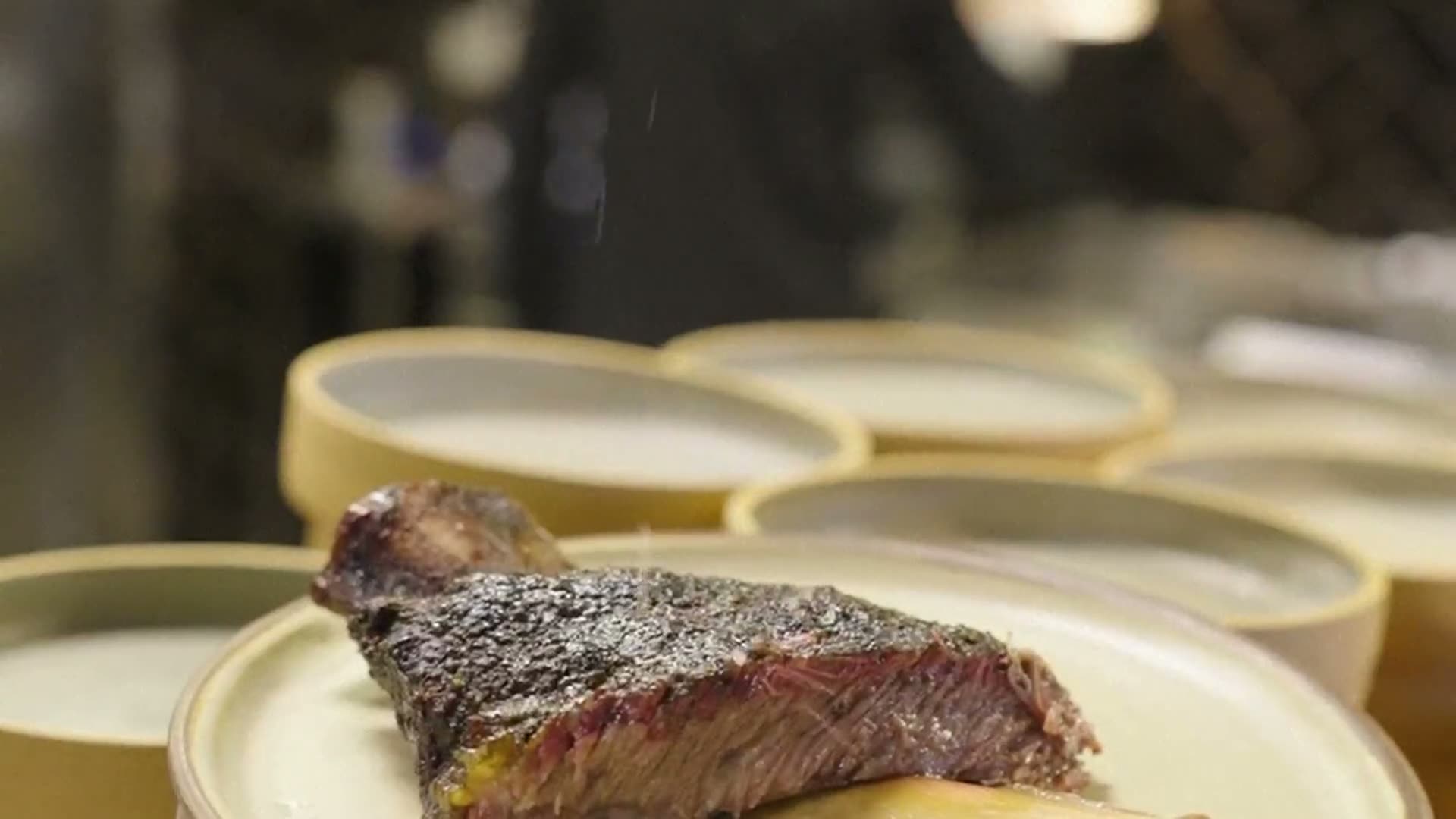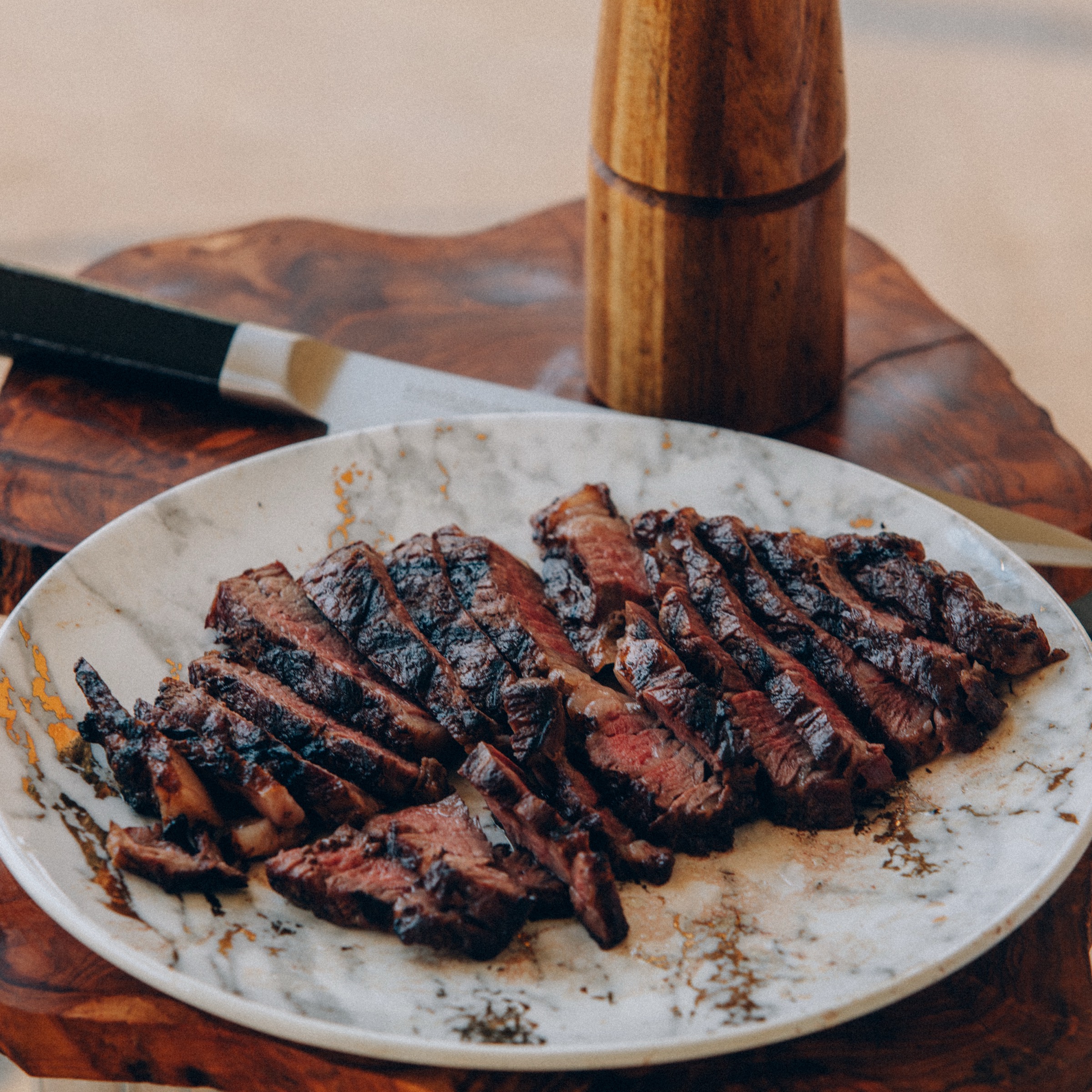
Three cuts appear on almost every steak menu. Here is how they differ in fat, tenderness and flavour, and where each one sits on Marble's menu.
There are many kinds of steak, but three cuts turn up on most restaurant menus: ribeye, striploin and tenderloin. All three come from the back of the animal, and all three are tender enough to cook quickly over high heat. They differ in three things: how much fat they carry, how tender they are, and how strong their flavour is. This piece explains each cut, then shows where you will find it on Marble's menu.
Steak cuts: how to read one
Three questions are enough to understand any cut. The first: how much fat is in it? That means marbling, the fine threads of fat inside the muscle, not the layer of fat on its edge. Marbling melts over the fire and gives the meat its juice and flavour, and it is where Marble takes its name.
The second: how hard did this muscle work during the animal's life? A muscle that moves a lot is tougher and richer in flavour; a muscle that barely moves is more tender and milder. The third: how will it be cooked? Tender cuts are grilled fast over high heat; tough cuts such as brisket need long hours at low heat.
So there is no single best steak cut for everyone. The best cut is the one that suits what you like: strong flavour and more fat, tenderness and less fat, or something in between. The three cuts here are among the best cuts for grilling, because they are tender by nature and need little time on the fire.
The fire itself is part of the result. At Marble we cook over samar wood and charcoal, never gas. The wood gives the steak its light layer of smoke; the charcoal gives the high heat for the crust.
Ribeye: fat and flavour
Ribeye is cut from the rib section. It has the most marbling of the three, and usually carries an eye of fat in its centre between two muscles. That fat is the source of its strong flavour and juice. People who like a clear taste of beef usually start with ribeye.
At Marble the Ribeye Steak is 350g, seared over samar wood for the flavour of smoke and served with caramelised lemon and salt flakes. Ribeye is also the cut in our Prime Rib: 400g over wood, with mashed potato, mushroom sauce and fried kale.
Elsewhere you may hear prime rib used for a large piece of the rib section cooked whole and then carved. The muscle is the same in both cases; what changes is how it is cooked and served.
Striploin: balance
Striploin, called New York strip on some menus, is cut from the lower back, behind the ribs. It has less fat than ribeye, and most of it sits as a strip along the edge rather than threads inside. The texture is a little firmer and the flavour is clear without being heavy. Because it is balanced, it carries strong sauces and flavours without losing the taste of the beef.
At Marble striploin comes in two dishes, each 200g. Miso Steak is grilled over charcoal with miso cream sauce and a fresh tomato salad in olive oil. Ponzu Steak is cooked over the flame and topped with green onion and Japanese ponzu sauce.
Tenderloin and filet mignon: tenderness
Tenderloin is a long muscle beneath the spine that does almost no work during the animal's life. That makes it the most tender cut on the animal and the leanest, with a milder flavour than ribeye or striploin. Filet mignon is a thick round steak cut from the tenderloin. Because it is lean, it is usually served with a sauce, a butter or a purée.
At Marble the Filet Mignon is a 200g angus tenderloin grilled over wood, with homemade garlic purée, truffle-oil asparagus and a potato-skin crisp. Tenderloin also appears in two smaller dishes: Tenderloin Foam, 80g of tenderloin on buttered potato foam with crispy chilli oil, and the Korean Taco, Korean-spiced tenderloin on a tortilla baked over the flame.
The comparison in three lines
Ribeye: high marbling, good tenderness, strong flavour.
Striploin: medium marbling, a slightly firmer texture, a clear and balanced flavour.
Tenderloin: little fat, the most tender, a gentle flavour.
Weight alone is not the measure. A 200g filet mignon may be enough for someone after tenderness, while a 350g ribeye suits someone who wants flavour and fat. Choose the cut first, then the size.
Which cut to order at Marble
If you are after flavour and juice, order the ribeye or the prime rib. If tenderness comes first, the filet mignon. If you want a balanced cut with a different flavour, the Miso Steak or the Ponzu Steak. And if the table is large, order more than one cut and share them; a comparison on the table is clearer than any explanation.
Every cut at Marble is chosen for its marbling first, by Chef Abdulrahman Alsowailem, a member of the International Beef Evaluation Committee and a judge at the World Steak Challenge in 2023. Tell the team how you like it done and they will cook it the way you ask. For the difference between the levels, read our piece on steak doneness (/en/blog/steak-doneness).
The cuts are on the steak page (/en/steak), and current prices are on the menu page (/en/menu). Book your table on the reservations page (/en/reserve).