Five levels, in Arabic and English, what each one means in colour and texture, and how to order your steak at a restaurant.
Steak doneness is how we describe what happens inside a cut on the fire: how much red is left in the centre, and how much juice is left in the meat. The names used in restaurants are mostly English, and guests hear them from the service team every day: rare, medium rare, medium, medium well, well done. Here is each level in Arabic and English, and then how to order it.
Steak doneness levels in Arabic and English
Rare (رير): the centre is red and glossy, and the cut is warm inside rather than hot. Very tender, with the most juice.
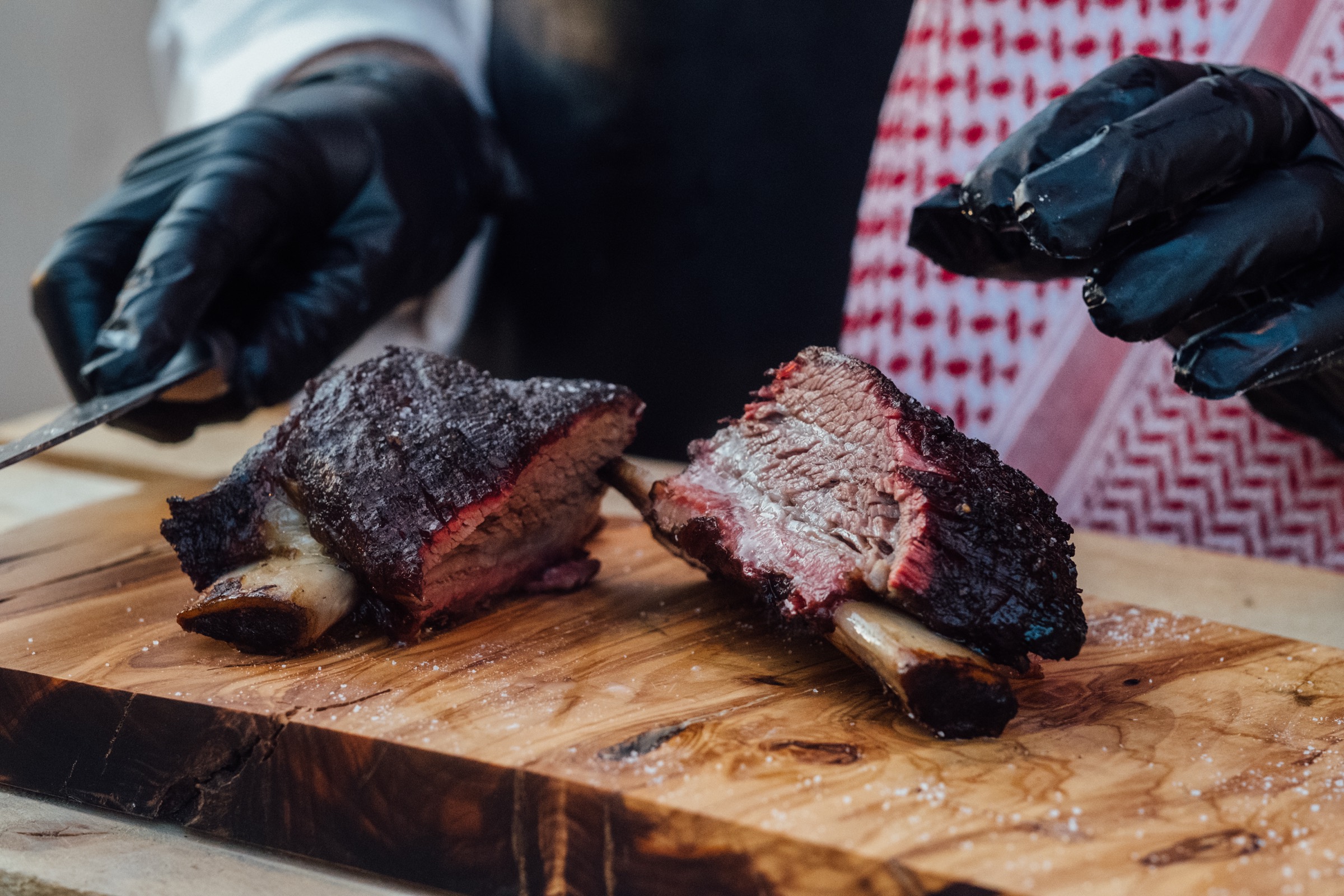
Medium rare (ميديم رير): the centre is pink leaning to red, the edges brown. Tender, with the fat starting to soften. Many cooks see it as the balance point between juice and texture.
Medium (ميديم): the centre is light pink and the brown band around the edge is wider. A little firmer, still holding good juice.
Medium well (ميديم ويل): only a faint trace of pink in the centre. Firmer, with less juice.
Well done (ويل دن): brown all the way through, with no trace of pink. Firmer, with much less juice.
Some restaurants have a level before rare called blue, where only the surface is seared and the inside stays almost raw.
What happens inside the cut
As the heat rises inside the meat, the muscle fibres tighten and push the juice out. That is why the more a steak is cooked, the firmer and drier it becomes. At the same time the colour changes: the red pigment in the muscle turns gradually pink, then brown.
The brown crust on the surface comes from high, direct heat, and it is what gives a steak the taste of the grill. The cook balances two things: a good crust outside and the right level inside. Over wood and charcoal that balance is a daily skill, because a live fire does not hold steady the way gas does. At Marble we cook over samar wood and charcoal, never gas.
Many people ask how long to cook a steak for each level. The honest answer is that there is no single number. The time changes with the thickness of the cut, its weight, how much fat it carries, the heat of the fire and the temperature of the meat before it goes on. A thick cut needs longer than a thin one of the same weight. That is why cooks rely on touch, sight and knowing their fire, not on the clock alone.
Why a marbled cut behaves differently from a lean one
Marbling is the fine threads of fat inside the muscle, and it is where Marble takes its name. That fat needs enough heat to soften and melt into the meat. So many cooks find that a well-marbled cut such as ribeye shows its flavour more clearly at medium rare or medium, once the fat has started to melt.
A lean cut such as tenderloin has little fat to protect it, so it loses its juice faster as the heat rises. That is why it is usually ordered at a lower level.
This is a general rule, not a law. The right level is the one you like. Ordering medium well or well done is not a mistake; it is a choice of a firmer texture and a brown centre, a taste like any other.
How to order steak at a restaurant
Say the name of the level as it is: medium rare, medium, or another. The English names are understood in steakhouses, and you can also describe what you want: a pink centre, or no trace of red. If you are torn between two levels, say so; an accurate description beats a name you are unsure of. You can also ask the team about the cut before choosing the level: how marbled it is, and over which fire it is cooked.
If the table is sharing one cut, agree on the level before ordering, because one cut is cooked to one level.
At Marble the team cooks your steak to the level you ask for. On our menu: a 350g ribeye over samar wood, a 400g prime rib, a 200g filet mignon, and 200g of striploin in the Miso Steak and the Ponzu Steak. For the difference between these cuts, read our guide to steak cuts (/en/blog/steak-cuts-guide).
After the grill: resting
A steak needs a few minutes off the fire before it is cut. In those minutes the heat keeps moving from the edges to the centre, so the level rises a little, and the juice settles inside the meat instead of running onto the plate when you cut it. That is why a steak is usually taken off the fire a little before the level it is meant to reach.
This step is part of the cooking itself, and one reason a rested steak differs from one cut straight off the fire.
After resting, a steak is usually sliced against the grain. That way the fibres in each slice are short, and the slice is easier to chew.
Our cuts are on the steak page (/en/steak), and current prices are on the menu page (/en/menu). Book your table on the reservations page (/en/reserve).